Supporter of the ‘underdog’ and fair play, freedom of the individual balanced with responsibility to the community. Supporter of our heritage and countryside. Environmental campaigner for action on climate change, sustainable farming, transport and economy
This autumn I had a DNA test and uploaded this to Ancestry.co.uk which resulted in some wonderful news – I am now in touch with cousins in North Wales who are related to my Welsh grandfather and grandmother. I will now have to update my Ient family web site! It is really exciting to be able to work with these ‘new’ cousins and piece together the family tree in Wales! My interest in history continues – and I have some good news, – my book about my dad and his fellow POWs in WWII is published! It’s an ebook and is on Amazon!
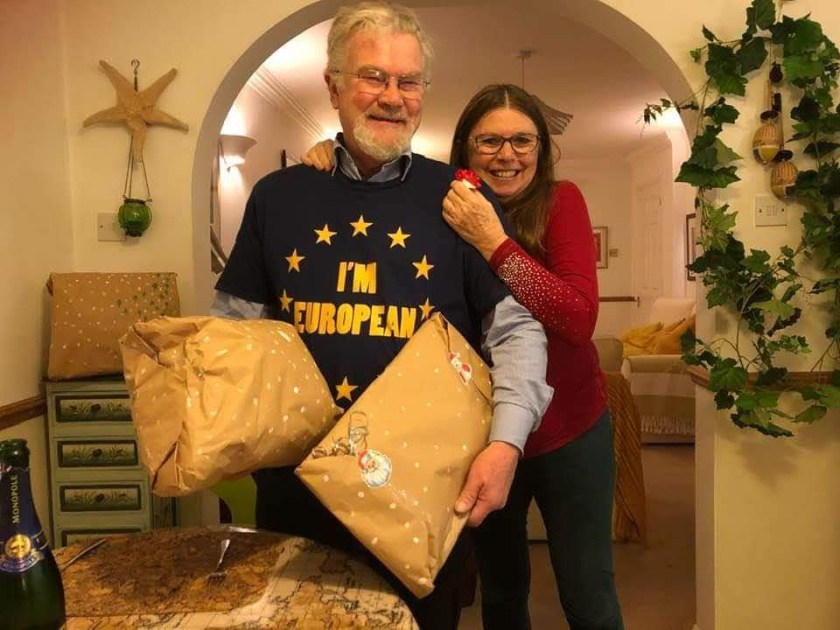
Carol and I have had enjoyable and busy year including attending my nephew Adam’s, wedding in July. It was wonderful occasion! It was great to see my son James and my granddaughter Mia over from Singapore in the summer. Next summer I am hoping to see them all (Emma and Mia with mum and dad, Niki and James). It has been good to see my son Adrian and grandsons (Edward, William and Thomas) down from Cambridge at various times during the year. I recently met them for a Christmas lunch in Cambridge. My, they are growing up fast – Thomas the eldest is 18 at Christmas! Also, I am lucky to have two step-grandchildren (Roscoe & Theodora) here in Lewes. They call me ‘Oggie’ so there is no confusion!
I have managed to squeeze into 2019 two great bike rides – one in Brittany/Normandy and the other to Spain cycling 600 miles along the Camino Santiago !
Seasons Greeting! and best wishes for the New Year!
These Valiant Men – The Story of Eight British Servicemen in World War II in the Far East – by Victor S. Ient
At last my book is published! For more info click HERE
It wasn’t until my father died, in 1988, that it dawned on me that I actually knew very little about his life as a soldier and more especially about his life as a POW. I had clues and snippets but I needed more if I were to write his story. My mother outlived my father by 11 years so I accumulated more little stories which were like briefly opening a ‘window on the past.’ I went on the hunt for dad’s fellow servicemen and POWs who were still alive. Luckily I actually met four of them and gathered the information about the other three with the help of contacts and descendants including Adrian Batty whose father was in the same POW camp as my dad. Adrian wrote the chapter about his father. I was also helped by an experienced WWII historian who has kindly written the forward, – Dr Tony Banham. The experiences of the other POWs has enabled me to fill the gaps in my childhood memories to make a full (well almost) account of what it was like for them from 1941 until 1945.
In the book I present you with the biographies of these eight men. It’s not all doom and gloom, as you will see. Of course, they describe some of the horrors, but their characters are strong. Their factual and sometimes humorous accounts have brought into focus what life was like in those terrible years.
There are many books written about and by great leaders and generals, but what about the ordinary guy? Their story is worthy of the telling as well. These eight were ordinary guys who were caught up in the global war during the 1940s, many of them young men, just finding their way in life who saw a career in the Services as adventure and travel. Little did they know what was to befall them in 1941! Read this book if you’re interested in understanding how, by accident and luck, I was able to piece together the circumstances surrounding my father’s capture and imprisonment. By investigating the lives of other servicemen who ended up in POW camps in Japan I’ve been able to tell my father’s story.
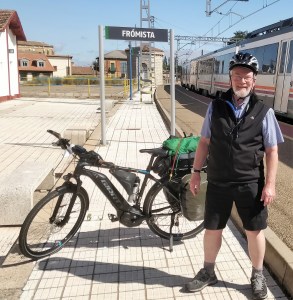
At the beginning of our journey along the Camino Frances
My colleague, Jonathan Gilburt and I have just returned from an amazing 600-mile cycle ride along the Camino Santiago in Spain! Over 16 days I cycled over 550 miles (885Km). Jonathan took an extra day and cycled close on 600 miles. See maps below
2020 Update! My cycling companion, Jonathan has made a short video of the trip:
The video (13 mins) kick off on a lovely sunny day in Plymouth where we spent the day , mainly in the 19th C dockyard before getting the ferry to Santander, Spain The maps below sketch out our cycle ride along the Camino Frances and then the Camino del Norte. It is a great record of the trip, – many thanks Jonathan!
What was amazing was the amount of ascent covered on the journey. The total ascent in my 16 days of cycling was over 41,500 ft. (12, 670 mtrs). Or, put it another way, it was like going up Ben Nevis (from sea level) 10 times in those 16 days, – one and a half times the height of Everest! I must admit I had some help though. At the age of 73 I thought I deserved some ‘power plus’. I had an electric bike, but Jonathan deserves full credit as he powered the whole of the journey under his own steam! Well, he’s 16 years younger than me so I’m very happy with my achievement. For both of us it was tough going in many places. On the level we were equal, – the electric bike cuts out at 15 miles an hour. Much of the time on the first part of the journey I was only on pedal power.
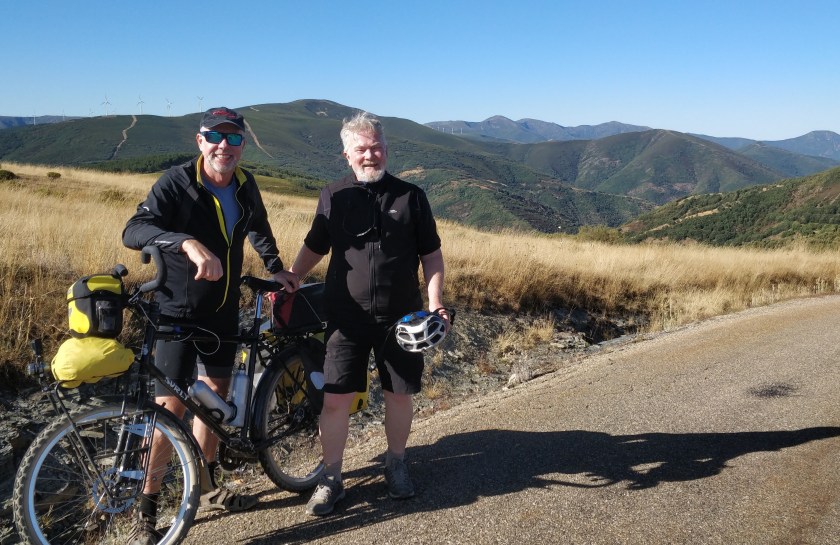
My cycling companion, Jonathan Gilburt and me in the mountains as we enter the region of Galicia
As many will know getting to Spain with your cycle isn’t easy. There are restrictions on the Eurostar and on the TGV. We wanted to go by ferry to Bilbao, but Brittany ferries said they don’t take bicycles, so we decided on Santander. From Santander we took the train south to join the ‘Camino Frances’ just west of Burgos. We then spent 7 days cycling through some beautiful striking and mountainous countryside to Santiago de Compostela. Having rested for a day we took the train north to Corunna and then cycled to Ferrol, another major Spanish seaport. We then took a short journey on the narrow gauge FEVE railway where we joined the north coast of Spain at a small fishing port with a beautiful beach, Covas. We then took 9 days to cycle the ‘Camino del Norte’ back to Santander. A wonderful journey by some truly beautiful beaches and craggy cliffs, – much like Cornwall. We went inland to and skirted beneath the beautiful range of mountains which run along the north coast of Spain, – the Picos de Europa before returning to Santander for the ferry journey home.
Stage 1 of our journey: Camino Frances (click to enlarge of download)
Stage 2 of our journey – Camino Del Norte (click to enlarge of download)
A talk by Peter Owen Jones at Pulborough Village Hall
Thursday 4th April 2019 – 7-9pm
Cost – £10 per person (includes a glass of wine & nibbles)
Peter Owen Jones is a maverick 21st century priest, ecological thinker and champion of ethics who, is an English Anglican priest, author and television presenter,well known from his BBC South programme on the South Downs called ‘In Search of England’s Green and Pleasant Land’.
He will be talking to us about his work, the filming of this documentary and the other fascinating stories that ended up on the cutting room floor, all infused with his love of the South Downs and the British countryside.
I’ve just had a very interesting conversation with my brother John. He is 12 years older than me, so he’ll be 84 currently but he’s got a good memory.
John Ient July 2016 – Richmond Yorkshire
He told me about his visit to Hong Kong in the 1960s whilst he was in the army. While he was there, he had a wander round to remember the places that he knew when he was a boy just before he, my brother George and my mum were evacuated from Hong Kong in 1940. John would have been about 5 years old then. He said they lived in two places –The Peak which you access via the Peak railway and near the racecourse in Happy Valley. I think The Peak must have been their 1st home. He says he tried to find out where they lived, and he remembered they had a view down into Repulse Bay. He asked the Chinese workmen where he could see this view and he was taken a short distance and shown a view. He asked the Chinese workmen where the houses had gone and he replied, “look down”. John looked down and saw the outline of foundations of buildings.
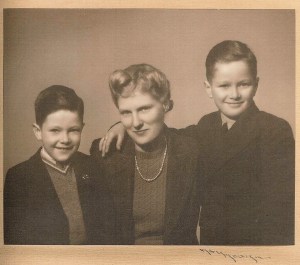
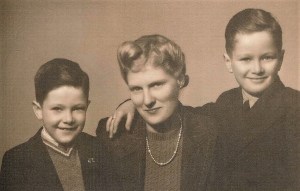
George (L) & John Ient (R) flank my mother in a photo taken in Manila, Philippines in 1940
John says he remembers being evacuated and has a memory of docking in Singapore as well as Manila in the Philippines. This seems a bit strange to me so I can only assume that in that evacuation of 1940 the ship may have gone to Singapore after the 2nd evacuation from Manila and sailed to Singapore before being redirected to Australia. I can’t be sure but maybe he’s mixing up his memory of a short visit to Singapore when the family went out to join my Dad in Hong Kong in 1938.
I asked John why Dad left the army in 1945/46. He said it was all to do with the POWs being sent to, in Dad’s case, an army camp at Pocklington Yorkshire. The men who had been in POW camp for 4 years were sent there for retraining to get them used to life back in the army. John said there was a sergeant, George Rockall who John met some years later in the mid-1950s when John was in the army serving at NATO headquarters at Fontainebleau in France. George Rockall was in charge of drilling the men on the parade ground at Pocklington in 1945. It was all to do with Dad’s reaction to this overzealous Sgt who John said looked very much like Captain Mainwaring of Dad’s Army. Apparently, Dad walked off the parade ground in the middle of being drilled as if he was a private soldier having just joined the army and asked for the papers so that he could resign from his service career.
After what Dad went through in the war I’m not surprised. Especially as Dad was a senior warrant officer in Hong Kong before he had been captured. He was an experienced soldier and I believe it was an insult to re-drill such men. However, as John says it was a decision which he believes Dad regretted. If he had stayed in the army, he would almost certainly have been made up to a senior warrant officer very quickly and probably would have got a commission as a major and served out probably another 15 years before leaving the army.
Sadly, Dad left the army and had to find a job. Things weren’t good after the war as there were lots of men looking for jobs as most of the service people had been conscripted into the services just for the war period and they were all on the jobs market as well. Dad had to start all over again in telecommunications. He joined the GPO telephone engineering department and began life all over again as a labourer digging holes and putting up telegraph poles. What must have added insult to injury was that he had to work through one of the worst winters in living memory in 1947 when he spent months repairing the telephone overhead wires and telegraph poles
Link to the Times article ‘The savage winter of 1947’
in the Basingstoke area in freezing weather and deep snow! Dad’s decision meant that our family didn’t have much money and mum had to go out to work. Luckily, being an ex-serviceman, our family was given a council house in Aldershot. In the end Dad did make the grade and became a manager in the GPO Guildford telephone area and was a very well-respected engineer and manager.
This BBC radio programme ‘In Our Time’ by Melvyn Bragg reveals what a long hard road it is to achieve civil rights but at the same time, one can only admire the courage and determination by the subject of this BBC programme, Frederick Douglass.
Frederick Douglass, who was born into slavery in Maryland in 1818 and, once he had escaped, became one of that century’s most prominent abolitionists. He was such a good orator, his opponents doubted his story, but he told it in grim detail in 1845 in his book ‘Narrative of the Life of Frederick Douglass, an American Slave.’ He went on to address huge audiences in Great Britain and Ireland and, there, some of his supporters paid off his owner, so Douglass could be free in law and not fear recapture. After the Civil War and the abolition of slavery, he campaigned for equal rights for African-Americans, arguing against those such as Lincoln who had wanted freed slaves to leave America and found a colony elsewhere. “We were born here,” he said, “and here we will remain.”
Railfuture is the UK’s leading independent organisation campaigning for better rail services for passengers and freight. Railfuture is a voluntary group representing rail users, with 20,000 affiliated and individual members. It is not affiliated to or funded by train companies, political parties or trade unions, and uses one-member one-vote democracy.
This is a fascinating story by Lord Ashdown (Paddy Ashdown). Whilst the story recounts the heroic actions of many SOE and French resistance agents, it focuses primarily on three people – a British secret agent Roger Landes; the Gestapo counter-espionage officer Frederick Dohse; and a French resistance leader André Grandclément who was responsible for most of the controversial betrayal that took place in France from 1942 to 1944. At first, I thought this was going to be documentary recounting the many conflicts between the Gestapo and the resistance and SOE in France. But it’s more than that, – it’s a gripping story that unfolds during World War II from the time the SOE agents are trained in England to the final days of the liberation of the Bordeaux area and the snub given to British agents by General de Gaulle. The book was clearly painstakingly researched – there are literally hundreds of references. Highly recommended!
This 90 minute film, tells the amazing and dramatic story of Gertrude Bell (1868 – 1926) who worked tirelessly to get the British Empire to do the right thing in the Middle East during and following World War I. The two features are the incredible story of her life and the vivid historical photographs. I highly recommend it. The narrator takes you on a journey through Gertrude’s life where she expounds on the critically and globally important issues of the day Whilst painting beautiful word pictures of the magic of the orient and life as it was during the decline of the Ottoman Empire and later in sharp contrast the stark reality of World War I. The film goes on describe the creation of new countries and rulers in the post-war period set against the hard commercialism of the British and American scramble for possession of oil rights.
Gertrude was a contemporary of T.E. Lawrence (Lawrence of Arabia) but far more influential. Sadly she has been almost completely written out of history. In large part, this film tells her story by the narrator reading from Gertrude’s letters set against a backcloth of original photographic and film footage from the period. Just seeing these Edwardian and wartime images and films is an historic feast in itself. If you want to see what Damascus, Baghdad, Cairo and the amazing ruins at places like Babylon & Palmyra were like just watch this film. The real Orient Express is also depicted with scenes at Istanbul and Baghdad. Despite the black-and-white imagery the desert scenes are stunning! There is also amazing footage from scenes in London and Paris. It’s an historians delight!
I was particularly struck by her very clear understanding of the circumstances and future challenges of the period. Much of what she says still rings true today! Here are a few quotes from her letters:
Talking about what would eventually become Iraq she said, “The first thing we should do in this country is to understand what is going on at the bottom of the Shia mind.”
As Britain began to occupy the new country of Iraq she said “The real difficulty under which we labour is that we don’t know exactly what we intend to do with this country. We rushed into this business with our usual disregard for a comprehensive political scheme.”
During World War I she said, “Can you persuade people to take your side when you are not sure if you will be there to take theirs?”
The film is currently available via BBC iPlayer, (also available to buy through other sources)
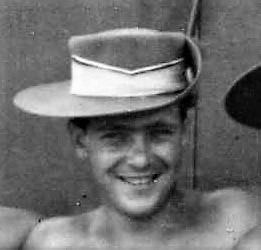
Royal Signals Corporal, George Ient at the British Army Nee Soon barracks in Singapore c1960
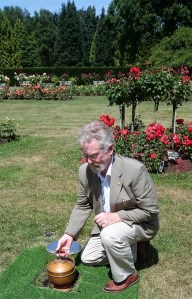
Last month George and I made our last journey together….. up to Aldershot crematorium from Portsmouth. I know this sounds a bit crazy since George’s funeral was in March but I had agreed that rather than have his ashes buried at the crematorium at Porchester, I would take them to Aldershot for them to be placed next to our mum and dad.
George Ient is laid to rest
George was born in Aldershot in 1937. After dad’s army posting to Hong Kong, mum and brothers George, Tommy & John joined him there in 1938.
George (left) with mum and John in 1942 – photo taken in Baguio, the Philippines
In July 1940 mum and my brothers wereevacuated to Australia where they spent the rest of WWII. Finally they returned to Britain in 1945 and following a brief spell staying with relations in South Wales and with Granny in Hounslow, Middlesex, George returned to Aldershot as an eight-year-old.
View from Crooksbury Hill
I spent many happy hours with George exploring the countryside, near our house, when I was four or five years old, until George, at the age of 15, joined the Army Boys Service. So I thought it most appropriate that he and I go on one last journey through those beautiful Surrey Hills, including Crooksbury Hill, which was the first place he took me on these explorations. Earlier this month, George and I went on that journey to his final resting place at Aldershot crematorium, just a few hundred yards from our home in Gloucester Road.



 Having rested for a day we took the train north to Corunna and then cycled to Ferrol, another major Spanish seaport. We then took a short journey on the narrow gauge FEVE railway where we joined the north coast of Spain at a small fishing port with a beautiful beach, Covas. We then took 9 days to cycle the ‘Camino del Norte’ back to Santander. A wonderful journey by some truly beautiful beaches and craggy cliffs, – much like Cornwall. We went inland to and skirted beneath the beautiful range of mountains which run along the north coast of Spain, – the Picos de Europa before returning to Santander for the ferry journey home.




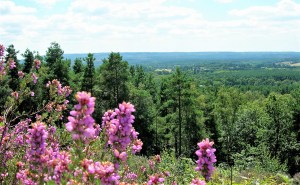
 through those beautiful Surrey Hills, including Crooksbury Hill, which was the first place he took me on these explorations. Earlier this month, George and I went on that journey to his final resting place at Aldershot crematorium, just a few hundred yards from our home in Gloucester Road.
