French Coast to Coast + Canal du Midi cycle trip 2024. A great trip cycling 631 km!
10th to the 24th of May 2024 by Vic Ient
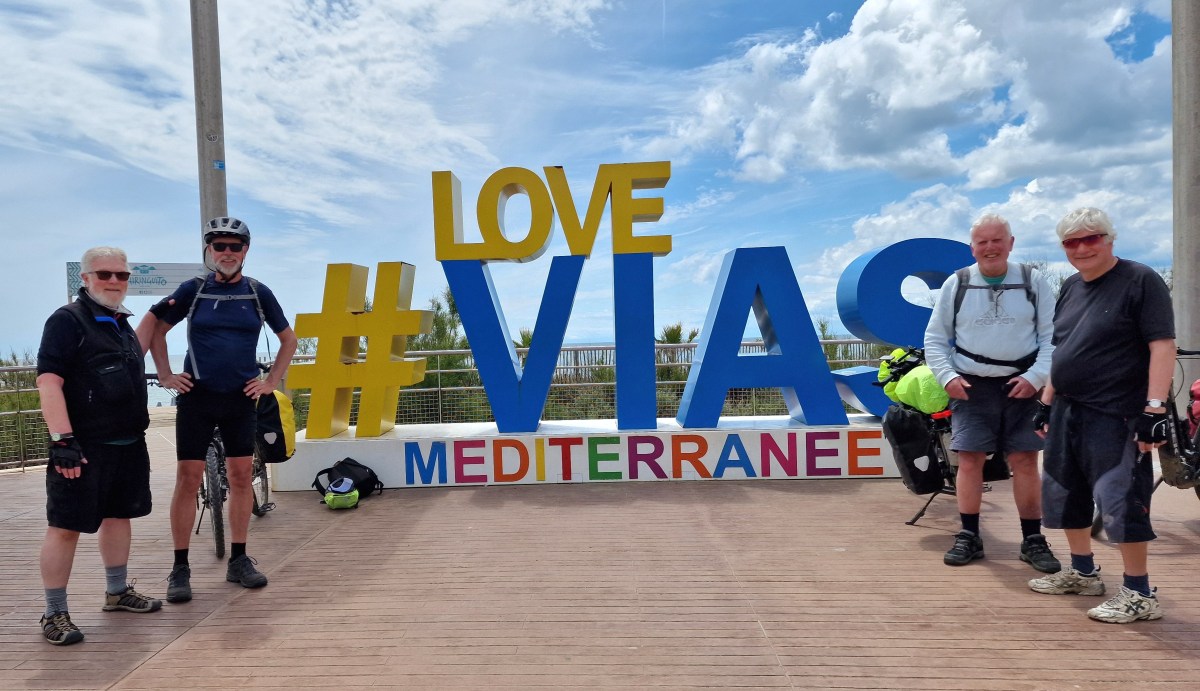
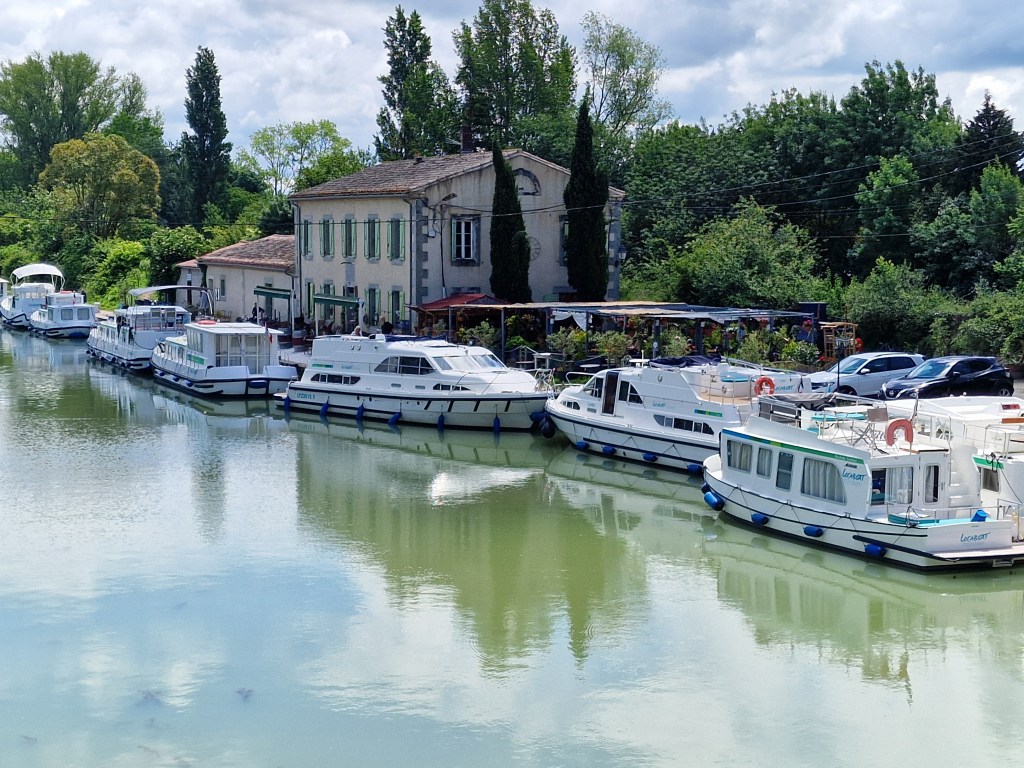
We cycled coast to coast starting in Royan on the Atlantic coast (Bay of Biscay), firstly along the Gironde, then the Garonne and then the Canal du Midi to Béziers and the river Orb to the Mediterranean coast!
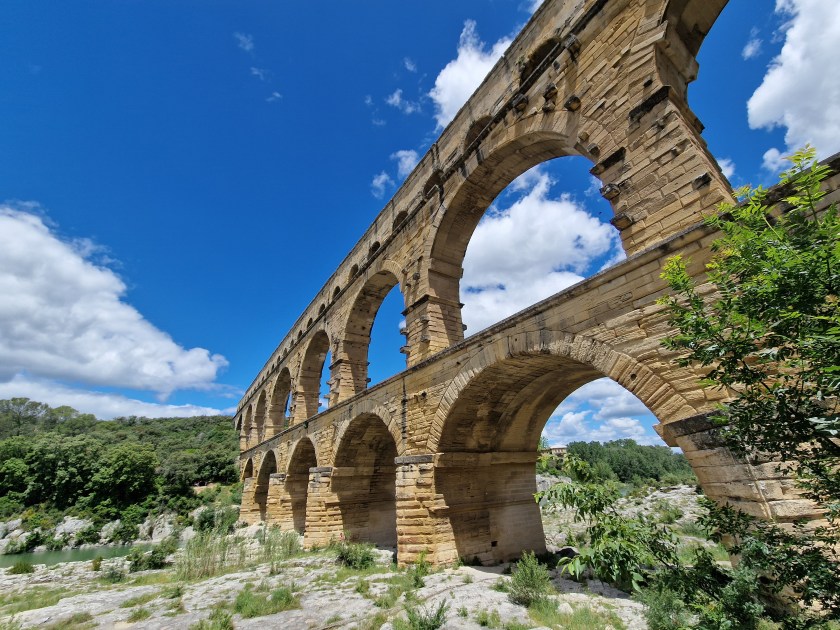
This was a great trip – we cycled 631 km (392 miles). Over 400 miles if you include the trip we did further east in Languedoc near Nimes in order to visit the amazing Roman aqueduct at Pont du Gard. Click: Photos trip details HERE.
Pond du Gard – Roman Aqueduct
Once we had arrived at Royan the task was relatively simple, – cycling 400 miles and enjoying visiting great places like the beautiful walled city of Carcassonne.
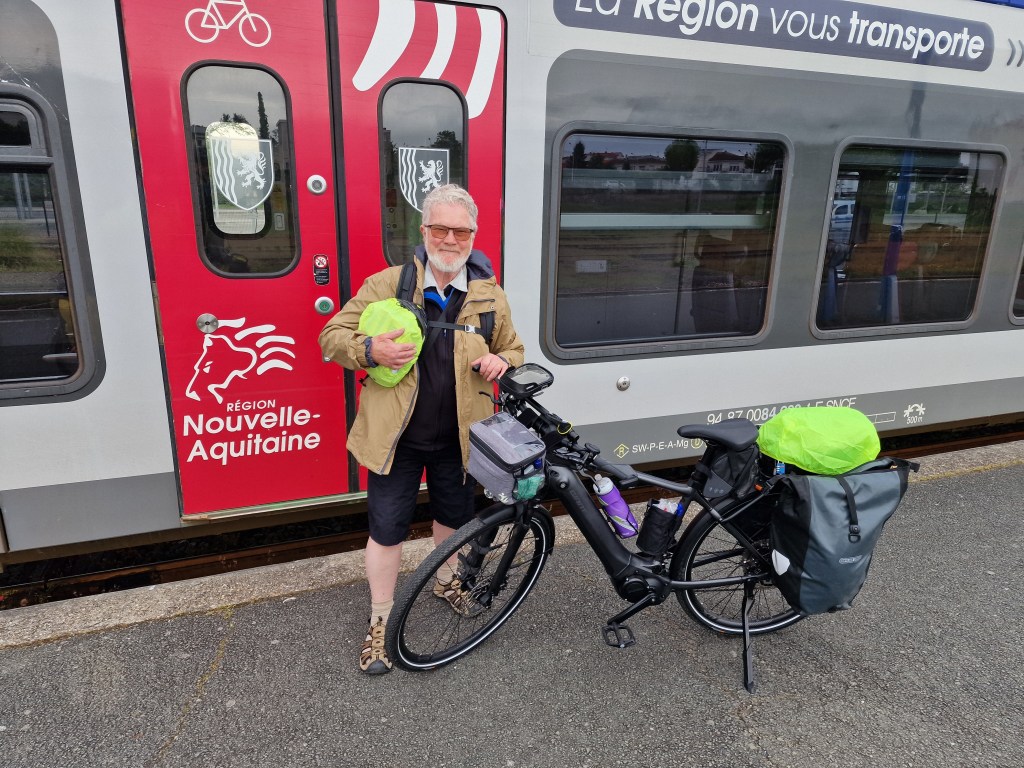
The hard work in setting up this trip was arranging the logistics and booking tickets for the train journeys across France to and from St Malo. Arranging the crossing was really a piece of cake and getting to and from Portsmouth was no problem.
The real problem was travelling by train with bicycles that will ‘fully assembled’. If we had bicycles which could be disassembled the journey would be relatively simple but electric bikes are not easy to disassemble and they don’t fit into a box or bag of a maximum size of 130 cm x 90 cm. Therefore, we had to find railway routes which allowed us to take our bikes on and off just in the same way as you would on local trains here in Sussex. The difference is we were covering much longer distances. From St Malo to the start of our journey was about 400 km (250 miles). However, with my growing knowledge of the French railway system I was able to achieve this, and we had the added benefit of staying overnight at the atmospheric old town in Nantes and at La Rochelle which is a beautiful ancient port on the west coast of France on our route.
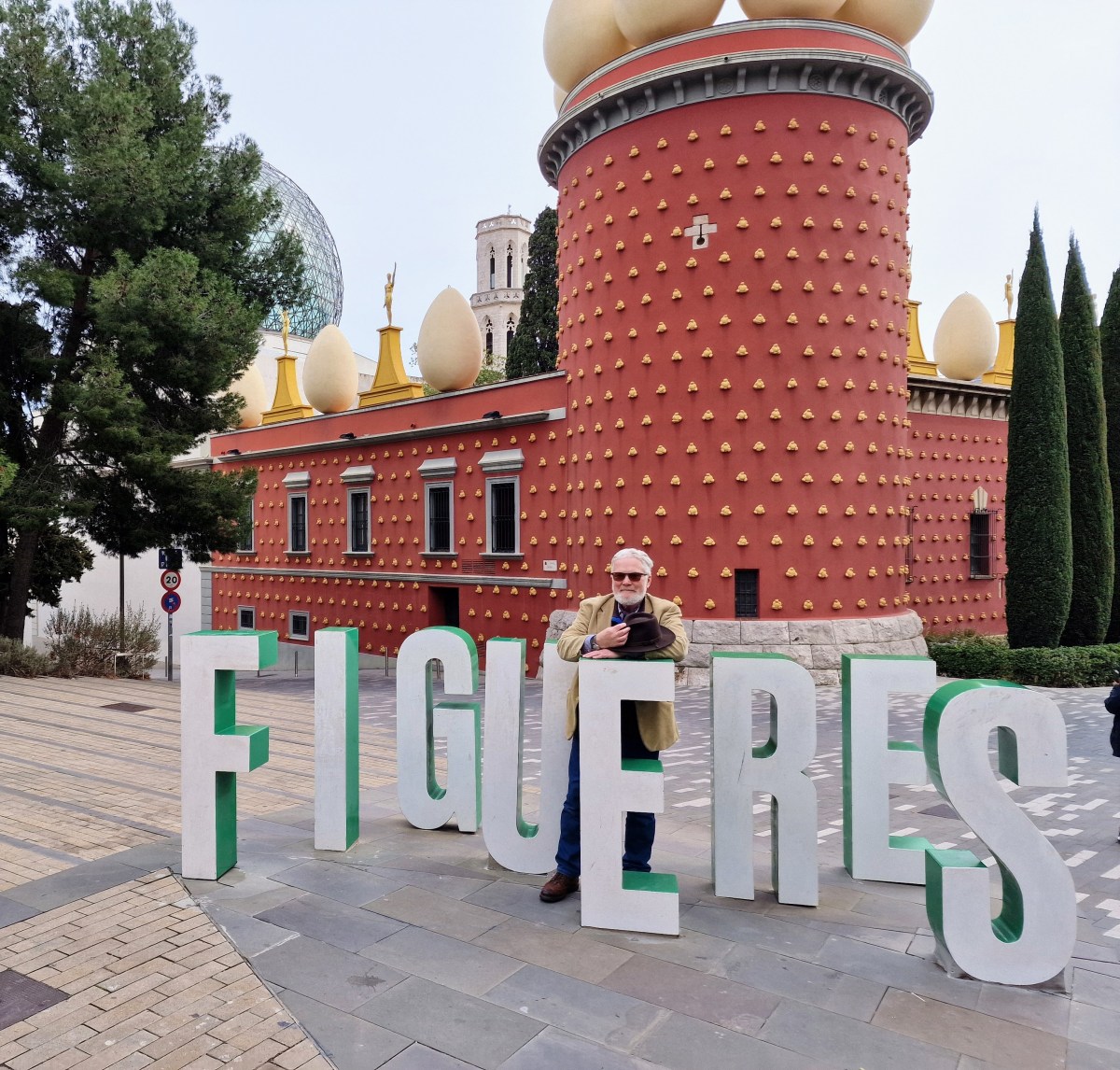
A great trip which took us to Paris, the Pyrenees, Perpignan, Figueres (Spain) and the Dalí Museum, Béziers near the Mediterranean coast, Nimes with its Roman colosseum and through the through the beautiful hills of Languedoc and the Massif Central.
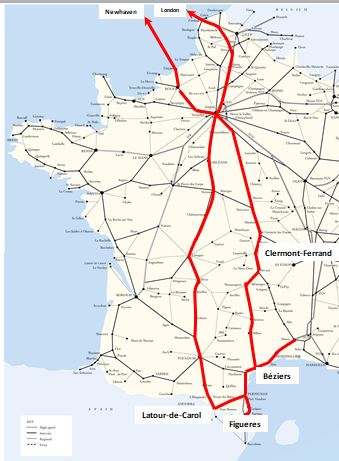
Including a night train from Paris to Latour-de-Carol in the snow-clad Pyrenees!
23rd February to 1st March 2024
A great trip which took us to Paris, the Pyrenees, Perpignan, Figueres (Spain) and the Dalí Museum, Béziers near the Mediterranean coast, Nimes with its Roman colosseum and through the beautiful hills of Languedoc and the Massif Central.
We journeyed over 2000 miles (3000 km) by train through France and Spain, (incl 250 miles on cross Channel journeys and in England).
After an evening meal at the Bistrot de la Gare near the Gare du Lyon we boarded an overnight train with the Intercités de Nuit from Gare d’Austerlitz, in Paris departing at 9:40 pm. By just after 10am the next day we were about 850 km south in the Pyrenees! The night train was a bit of a letdown as the sleeping compartments were really no more than cushettes with a light duvet. If we had booked earlier enough we could have been travelling for about €30 but we left it too late and had to pay a lot more. However, I’m very grateful to the English speaking service of SNCF for actually getting us on to the train because of its popularity. I had forgotten that in February the Pyrenees is quite popular for skiing and the train would be quite full. Sleeping cars consist of 6 berth for 2nd class and 4 berth for 1st class. The other dissapointment was that the buffet car had been disconnected at Toulouse, so no morning coffee and croissant for us! Thankfully we were able to have our petit dejeuner at the station café in Latour-de-Carol. Despite these inconveniences the journey we arrived on time in the heart of the beautiful Pyrenean snow-topped mountains, bathed in sunshine!
Click HERE for the photos of the journey including the Pyrenees
Below are some photos of special interest: (click the heading of each section for photos and or the link in the text for more information)
The Ligne de Cerdagne, usually referred to as Le Petit Train Jaune, (the Yellow Train) is a 1m gauge railway that runs from Villefranche-de-Conflent to Latour-de-Carol-Enveitg in the French Pyrenees.
I had miscalculated things in my researches as I thought the Little Yellow Train was operating but when we got to Latour-de-Carol I found it was closed for winter maintenance. However there was a silver lining. We were soon able to board a bus costing only €1 which would take us on a road parallel to the train route so we could see all the many amazing railway viaducts cut into the mountainside. When we arrived at Villefranche-de-Conflent we were able to see these wonderful little trains all sitting in sideings ready for use in the spring and summer. Our onway train journey to Perpignan was also only €1 !!
This heavily fortified village in the Pyrénées-Orientales is a UNESCO World Heritage Site. When the territory was ceded to the French in the 17th C the town became an important French defence against possible Spanish incursions. We had a great lunch in a restaurant which was had very thick stone walls. Atmospheric and very welcoming!
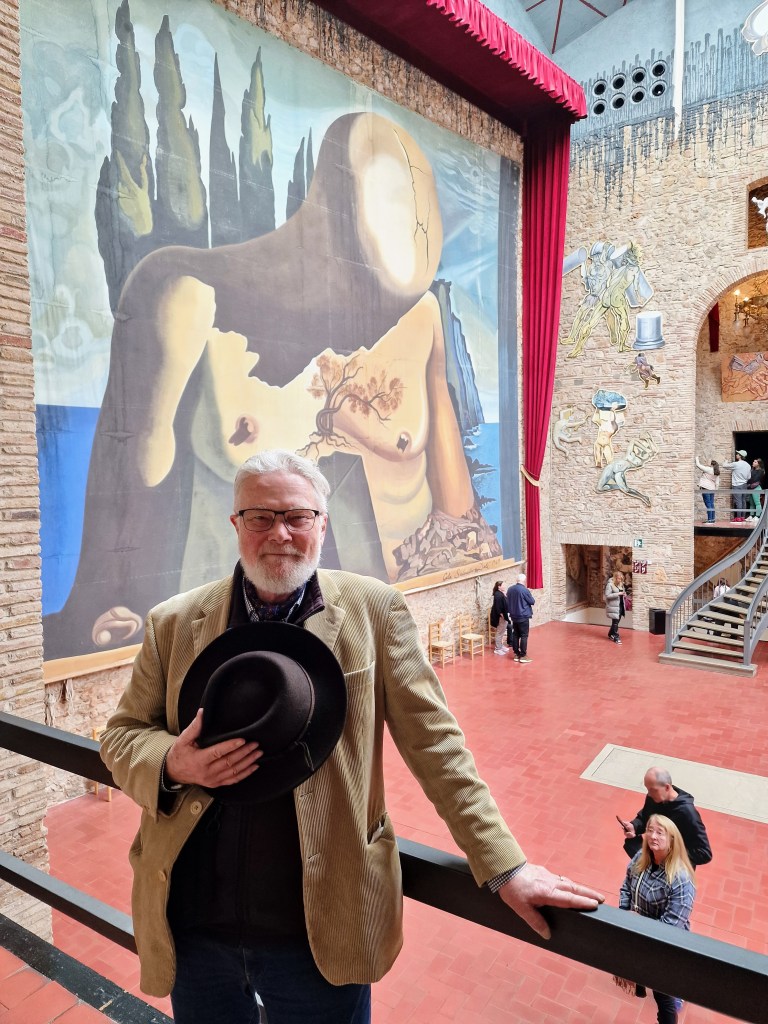
This was the highlight of our trip! – I was blown away by the number of artistic pieces, their variety and quality! See the special page for photos on the link as above.
Through the beautiful hills of the Mediterranean in the Languedoc region to the Massif Central leaving behind small stations and villages with red terracotta roofed houses and far ranging views into the hills, some with beautiful limestone escarpments and fast flowing rivers in gorges lined by trees below us. In the far distance I even caught sight of the snowy tops of the Massif Central mountains.
This was the highlight of the train tour through France and Spain which my friend Norman Baker and I took in February. I was blown away by the number of artistic pieces, their variety and quality.
Dalí Museum – Figueres, Cataluna Spain 25 Feb 2024
This was the highlight of the train tour through France and Spain which my friend Norman Baker and I took in February 2024. We were blown away by the number of artistic pieces, their variety and quality. It is the best art exhibitions I have ever seen in the whole of my 78 years on this planet. You have just got to go and see it to believe the fantastic art!
I quote from one guide “The Dali Theatre Museum is definitely something worth experiencing, if not to get a better understanding of Dali, then at least to enjoy the opportunity to witness the creative eccentricity of an artist like no other”.
Figueres is the birthplace and final resting place of iconic Surrealist artist Salvador Dali. The town is also home to the Dali Theatre-Museum, a masterpiece of surrealism that the artist designed himself.
Great cycling trips and days out including Coast to Coast in France along the Canal du Midi!
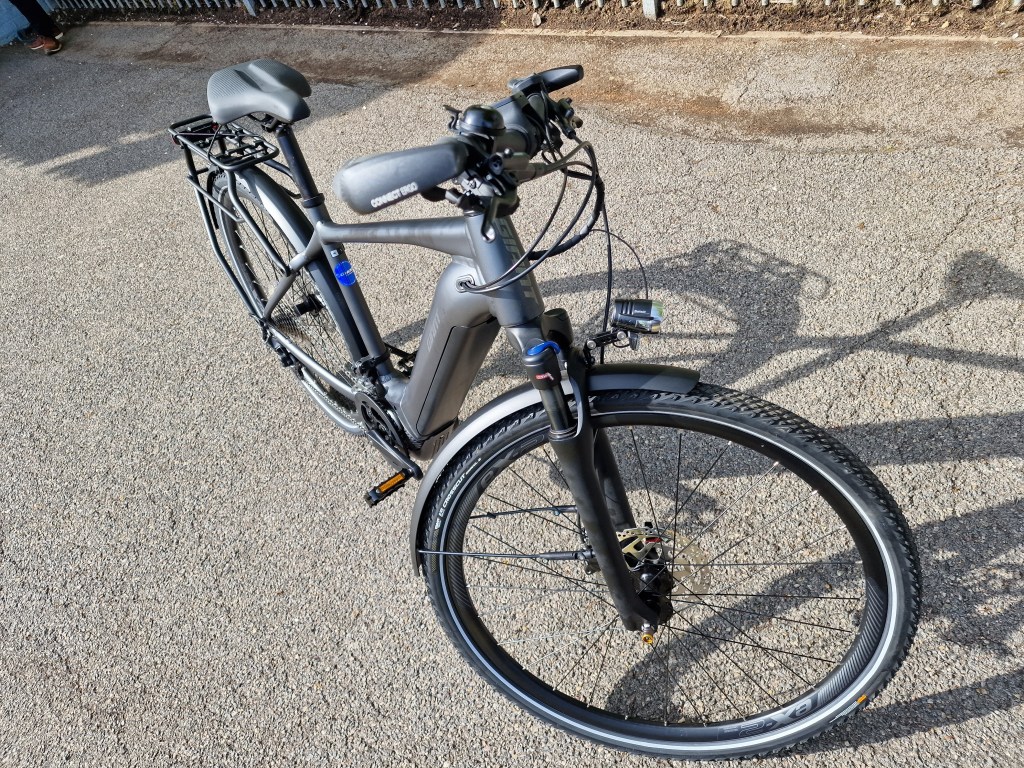
Total distance covered in 2024 was = 2240 km (1392 miles) since collected my new 800W Giant Explorer electric bicycle in May. This has a fantatic range – mile for mile much better than my 2019 500W Giant Explorer.
Some great trips to France and some wonderful days out in Sussex. I also managed to combine cycling with trips to Lyme Regis which were wonderful in the beautiful autumn days. These trips don’t include the Monday morning bike rides with John’s group here in Lewes. Unfortunately I didn’t have my Garmin for the first four months of the year so I don’t know what distances I covered in this period.
Canal du Midi – Coast to Coast Cycle trip
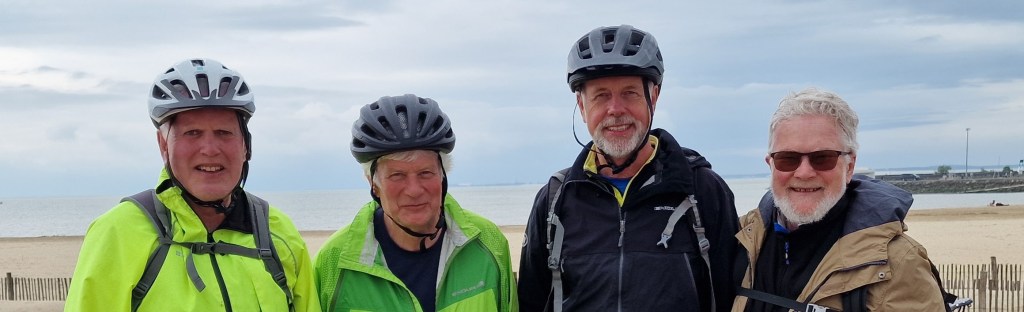
Johm, Martin, Jon & Vic at the beging of the Coast to Coast cycle trip at Royan, at the mouth of the river Gironde
The Coast To Coast cycling distance was 631 km (392 miles)
Edward, Adrian & William on the quayside opposite the Restaurant Le Cap, on the Rue du Port, Barneville-Carteret on the west coast of the Cherbourg peninsula, France
A 2 week touring holiday in northern Spain, visiting 3 historic and beautiful cities with our EV car. 600 miles and zero global warming emissions. A fantastic visit to three beautiful ancient cities
A two-week touring holiday in northern Spain:visiting 3 historic and beautiful cities with our EV car
Just over 950 km (600 miles) -Three time the distance between London and Manchester. One charge en route an 2 short charges at hotels (one free!). Zero CO2 emitted and zero global warming emissions from our car!
April 2023
By Ferry from Portsmouth to Santander
For some time we had wanted to visit the wonderful historic cities of Salamanca, Segovia and Ávila in western Spain and in 2023 we decided to make it happen by travelling first by ferry to Santander in northern Spain. We decided to check out Brittany Ferries new low emissions ship, Santoña (fuelled by LNG instead of dirty old marine diesel oil). It certainly was a much more pleasant experience as when on deck you didn’t get that smelly smoke in the downdraft depending on which way the wind was blowing. We then had the question of shall we take the car or shall we go by train to these cities?
Travelling in Spain by electric car or train?
It is certainly possible to travel by train, on the often new, electrified service. However I wanted to experiment in taking my electric car abroad. It’s a Kia Niro with a 64.8 kWh battery with a range of about 285 miles. Over the three years that I’ve had this car I’ve found that the manufacturer’s range prediction to be pretty accurate.
Having done some research on recharging stations, I was confident that we could make the journey despite the fact that the distances on the rural sections of our trip were sparsely populated with charging stations. My confidence was boosted by the relatively good range of our Kia Niro EV car as it was clear that whilst we may not find a charging station out in the countryside or going through the Picos de Europa mountains we would certainly find stations in the bigger towns. For day one of our journey in Spain I was fairly safe in the knowledge that we could call into the large city of Burgos to refuel before going on to Salamanca. The total distance between Santander where the ferry arrived and Salamanca is 265 Miles (426 km). I realised the range of my car would not cover this distance in one hop.
Charging your car abroad
The other question which arises is how do you charge your car abroad? It was clear one had to get a charging card from one or other suppliers. I didn’t want to get tied down to a supplier for only one country as this would be limiting on future visits to other European countries. After some brief research I found that taking up membership with Chargemap would give us access to a wide range of charging stations across Europe no matter who the local supplier was. You have to sign up for their card which costs €19.90 for a one-off purchase. Their app also provides you with a map of all compatible stations in the country you are driving through. I decided that it was worthwhile getting this card rather than relying upon the possibility of just using a credit card or using my European Shell Recharge card. Shell had lots of EV recharge stations in Europe but didn’t have any in Spain. On the other hand the Chargemap service seemed to have loads of stations on their map. This turned out to be correct as the main Spanish petrol and diesel fuel supplier, Iberdrola, also provided most of the intercity and motorway charging stations. It was clear that the Chargemap service was compatible with the Iberdrola stations.
At Portsmouth we recharged at the Instavolt fast charging station which is within the ferry port area. This was hugely convenient as we didn’t have to stop on the way to Portsmouth and we would be ready to go immediately on arrival in Spain.
Santander to Salamanca
After a very pleasant crossing we arrived at 8 am. We set off on the old main road south towards Salamanca. It was a lovely journey through the Picos de Europa and the road was relatively quiet as most of the traffic uses the autopista (motorway). Once though the mountain range we entered the high plains of the Castile and Leon province. We called into Burgos to recharge the car. We had looked for charging stations on the road down to Burgos but the few we saw were still in construction. It was a bit confusing in Burgos because my onboard map system didn’t make it clear where the charging stations were. I believe it was out of date, So we used the Chargemap map on my smartphone. This made things a little difficult because I was the driver and couldn’t look at the app and drive at the same time. After a number of stops we eventually found an Iberdrola co located with a fuel station.
We were pleasantly surprised when we got to our hotel in Salamanca (the NH hotel Palacio de Castellanos ) as it had two charging stations in the garage. The concierge helped me load down their own app so we were able to charge up ready for when we left Salamanca.
Salamanca is a beautiful ancient university city and is well worth a visit. The central part of the city is a UNESCO world heritage site because of its important historical and architectural heritage. It has many stunning buildings, pedestrianised streets and great restaurants.
Our next stop was the ancient fortified town of Ávila. It was only just over 100 km away, well within the 400 + km range of our car. Again, we were pleasantly surprised when we got to our hotel, the Parador de Ávila, as this also had charging stations in the garage and this time they were free! Avila is absolutely worth visiting for its remarkably well-preserved mediaeval walls and historic architecture.
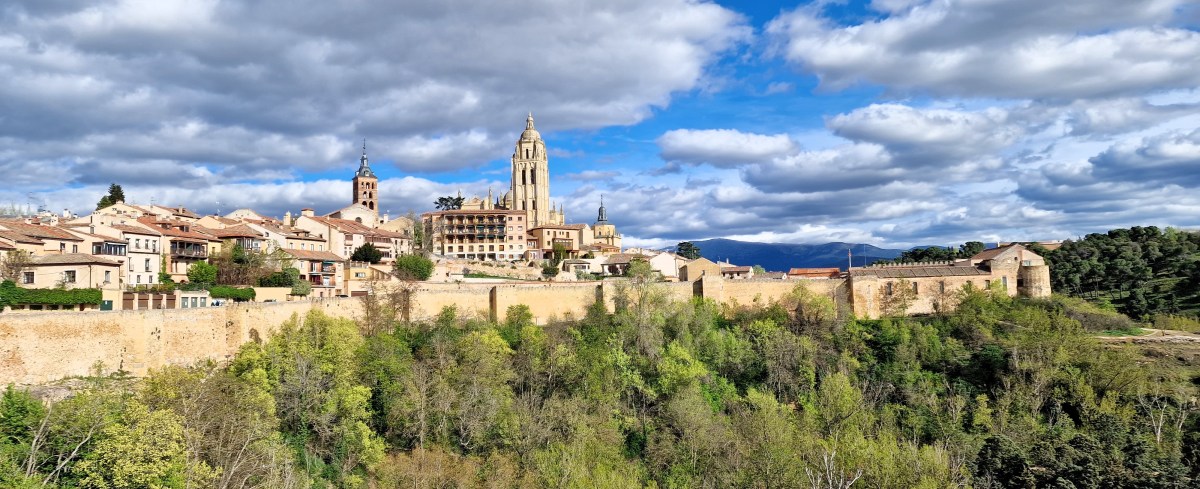
Our next stop was just 65 km east to Segovia. Our hotel was in the central plaza mayor and they operated valet parking so we were unable to charge. However we weren’t worried about this as we had over 350 km range remaining. Segovia is another world heritage city; a must see is the massive Aqueduct of Segovia. It is the defining historical feature of the city. It was built by the Romans in the first century AD to channel water from springs in the mountains 17 kilometres away. Another must see is the Alcázar (palace). It may have had Roman origins but certainly by being called ‘alcázar’ it was probably a Moorish palace prior to the ‘reconquista’. It has been much modified over the centuries and now resembles a German castle more suited to the banks of the Rhine in Bavaria with its tall towers overlooking the surrounding plains and countryside on the edge of the city. It was one of the favoured residences of the kings of Castile.
After a fantastic visit to these three beautiful ancient cities it was time for us to journey back to Santander to get the ferry home. The distance to Santander is just over 360 km (226 miles)so we didn’t need to charge on the way back to Santander.
Conclusion
Since the trip to Spain my car has been in for a service and the onboard map has been updated. I should have made sure it was updated at the previous service. However the Chargemap app was very good and using their mapping tool was accurate. You just have to plan things a bit more carefully to avoid having to keep on stopping to look at the app.
I was very impressed with two of the hotels we stayed at who had their own charging points. This made life a lot easier. As far as charging on the motorways are concerned I expect that those we saw under construction are now working and that should also make life a lot easier as driving around a city trying to find a charging point in a country you don’t know very well isn’t easy.
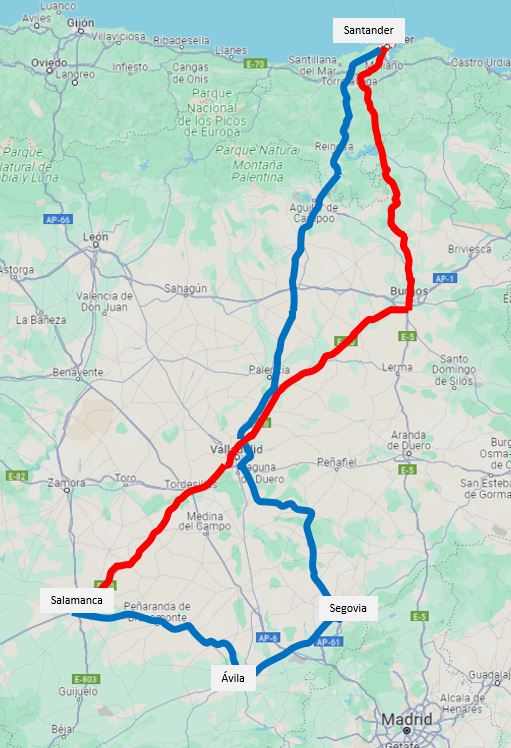
Map of our Journey: red is the outward journey and blue the return





 Vic Ient